
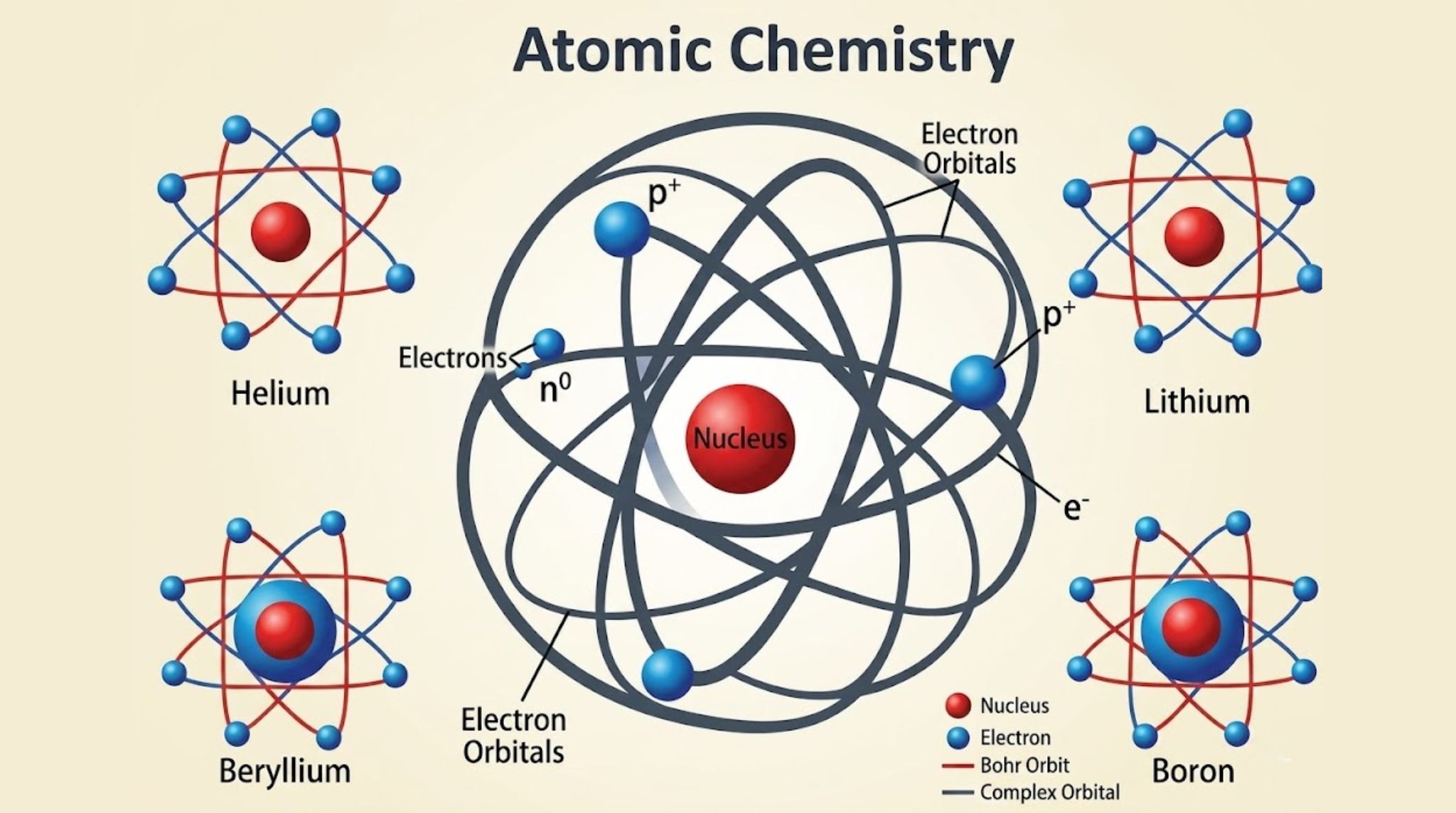
Grasping the Basics of Atomic Structure: Required for NEET Chemistry
Basics of Atomic Structure
Atomic size is one of the most important factors in chemistry, where we seek to explain the types of substances, their forms, and changes in the interaction of different substances. This document focuses on commonly asked questions in the option of NEET Chemistry, others like astronomy, the structural concept of elements in molecules, the nature of electromagnetic radiation, and the photoelectric effect.
NEET Chemistry Atomic Structure Study Notes
Nature of Electromagnetic Radiation
In other words, the energy that is released and possessed as alternating electric and magnetic fields that propagate in empty space is known as electromagnetic radiation. This kind of energy radiation is massive, differing from X-rays, UV rays, visible rays, gamma rays, infrared rays and microwave ranges to the radio frequency range.
Electromagnetic Spectrum Overview

- Gamma Rays
- X-Rays
- Ultraviolet (UV) Light
- Visible Light
- Infrared (IR)
- Microwaves
- Radio Waves
The Photoelectric Effect
One typical definition of the effect is the ejection of electrons from a metal plate when light strikes it. This phenomenon was a catalyst for the development of quantum physics.
Explanation by Einstein of the Photoelectric Effect: According to Einstein the photoelectric effect is the light that has particles called photons, which are considered to be energy vectors of light. The energy of every photon is described as follows:
E=hν
The kinetic energy of the ejected electron is defined as:
KE=hν−ϕ
Spectrum of the Hydrogen Atom
The hydrogen atom, with its single electron, serves as a simple model for studying atomic spectra.
Balmer Series: It is expressed as:
Bohr Model of the Hydrogen Atom
Bohr’s model proposed the idea of quantized orbits, thereby explaining the atomic stability and atomic spectra.

Key Postulates of the Bohr Model
Quantized Orbits: At set energy levels, electrons revolve around the nucleus.
Angular Momentum Quantization: It is given by:
Energy Levels: The electron’s energy in a particular orbit is:
Radiative Transitions: Electrons move between orbits by absorbing or emitting photons with energy equal to the difference between initial and final energy levels.

Limitations of the Bohr Model
Multi-Electron Atoms: It cannot accurately predict spectra for atoms with more than one electron.
Zeeman Effect: It does not explain spectral line splitting in magnetic fields.
Wave-Particle Duality: It overlooks the wave nature of electrons, later addressed by quantum mechanics.
Limited Accuracy: The model’s predictions are precise only for hydrogen-like atoms.
NEET Preparation: Importance of Atomic Structure
Conceptual Clarity: Furthermore, revision of the theory of the atom is beneficial in solving even the most complex issues in physical and organic, as well as inorganic chemistry.
Interdisciplinary Relevance: Parts of chemistry such as atomic structure, quantum theory, and propagation of particles in waves have indivisible relations with the area of physics.
Improvement of skills: Understanding the concepts of atomic structure, involving mathematical formulations and derivations, reinforces problem-solving abilities and that is important for achieving high score in NEET.
New approach Questions: NEET involves questions on data interpretation and observations of experiments which depends on photoelectric effect and knowledge of atomic spectra.
Preparation for Higher Studies: Mastering atomic structure aids NEET success and builds a foundation for medical and dental courses where strong basic science knowledge is critical.
Readiness for Further Studies: Command over atomic structure not only helps clear NEET but also prepares the ground for medical and dental studies where a good command of the basic sciences is necessary.
Enhances self-esteem: A firm understanding of atomic structure enhances self-esteem and readiness to sit for examinations.
Further Reading
For those interested in going deeper into atomic structure and related phenomena, the following resources are recommended:
- “Principles of Quantum Mechanics” by R. Shankar
- “Quantum Chemistry” by Donald A. McQuarrie
- “Introduction to Electrodynamics” by David J. Griffiths
Happy studying!
FAQs about atomic structure for NEET exam preparation
1. Understanding of electromagnetic radiation is considered important in Neet. what is the reason behind that?
Learning electromagnetic radiation helps in understanding the processes like the atomic emission spectra and photoelectric effect, which are frequently covered in NEET.
2. Why photoelectric effect can be a crucial topic in the chemistry course of NEET?
The photoelectric effect shows that light has a particle aspect, making students apply the concepts of energy quantization and motion of electrons both in chemistry and physics, and therefore it can be included in NEET.
3. Does the Bohr model come in the NEET exam?
Bohr’s model is important in explaining the atomic structure and also the spectral lines. Thus, questions concerning the energy levels and radius of orbits of an electron as given by this model in most NEET examinations are common.
4. How will knowledge of atomic spectra be useful in NEET preparations?
Knowledge of atomic spectra assists in the understanding of the emission and absorption spectra, which assists in the identification of elements, a common topic in NEET.